
Phoenix Local
Artificial Turf for Every Yard
STC Certified installers with 10 years of desert-proven synthetic grass projects across the Phoenix Valley.
Free estimate
Tell us what you need
Three fields. It reaches a person here, not a call centre.
Cool Turf That Outlasts the Desert Heat
Updated October 2026
Cool turf isn't just a selling point in a climate that hits 115 degrees. It's a real engineering consideration, and it's one of the first things we address on every artificial turf installation we take on. The synthetic grass we install is selected for heat-dissipating fiber technology, proper infill depth, and drainage capacity so that your yard stays cooler underfoot and drains a monsoon in minutes. InfinityTurf Landscaping LLC holds an STC Certified Installer credential, has a 4.9-star rating across 27 Google reviews, and has completed over 200 documented projects across the Phoenix Valley. Call us before you commit to a product or a bid from anyone else.
What separates a turf job that looks great for six months from one that holds up for fifteen years is the base preparation. We excavate the existing material, address compaction and drainage grade, lay a class-II crushed aggregate base, and compact it in lifts before a single roll of synthetic grass touches the ground. The turf itself is cut and seamed to eliminate visible joins, then secured at the perimeter and cross-nailed through the field. Infill is applied by type and depth to match how the yard will be used, a pet-friendly artificial grass install gets a different infill spec than a front-yard showcase. Scope, square footage, existing ground conditions, and the turf product you select are the main cost drivers. Every job is different, contact InfinityTurf Landscaping LLC for an accurate estimate.
Every Turf Application We Install Turf Application
One crew handles the full scope, from demo through final brush, across every residential turf type.
Front Yard Lawn Turf
High-pile, natural-colored synthetic grass shaped to your lot lines, edged clean against pavers or decomposed granite, and finished with a directional brush so it looks freshly groomed every morning without any effort from you.
Pet-Friendly Turf
Perforated backing with a crushed-stone sub-base provides rapid vertical drainage. We pair it with an antimicrobial infill that neutralizes odor at the source. Your dog gets grass. You don't get the smell.
Poolside and Patio Turf
Chlorine and constant foot traffic are hard on inferior products. We spec UV-stable, non-absorbent fiber that won't bleach, mat, or retain pool water, and we cut it tight to paver edges so the transition reads as intentional.
Custom Putting Greens
Low-pile putting turf installed over a precision-graded aggregate base. We can build break into the green by adjusting the sub-grade elevation during prep. You can't add that after the turf goes down.
Playground Safety Turf
Thick-pile, high-cushion synthetic grass installed over a compacted and graded base to meet fall-height requirements under play structures. Softer landing, zero mud, and no grass seed that gets worn to bare dirt in two months.
Side Yard and Run Areas
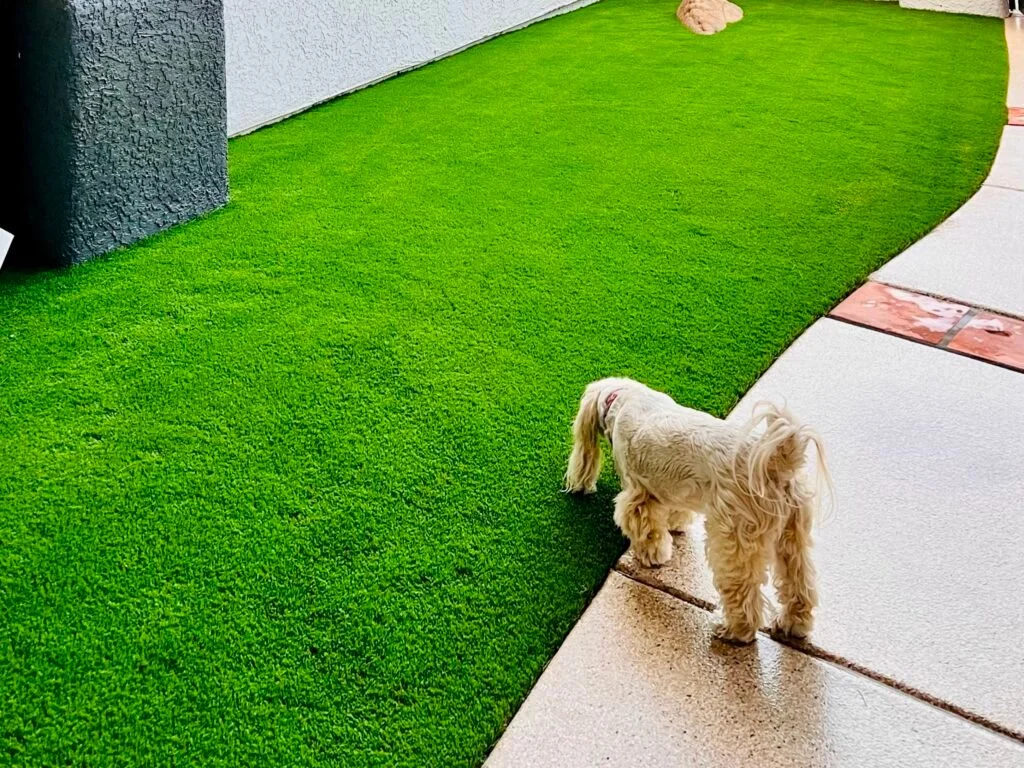
Narrow side yards get overlooked but they're often the most used space for dogs and kids. We install turf in tight corridors with the same base prep standards as a full backyard. It's either done right or it fails.
Our Process
How We Install Synthetic Grass Install
The process is the same whether the job is 400 square feet or 4,000. We don't shortcut base prep on small yards.
- 01
Demolition and Site Prep
We remove existing grass, gravel, or hardscape as needed through our demolition services, excavate to grade, and address any drainage issues in the sub-base before we build up. What's under the turf determines how long the turf lasts.
- 02
Base Construction
Class-II crushed aggregate is installed and compacted in lifts to create a stable, permeable base. We check grade and drainage direction at this stage. Not after the turf is down.
- 03
Turf Installation and Infill
Rolls are cut and seamed to eliminate visible joins. Perimeter is secured, field is cross-nailed, and infill is applied by type and depth to spec. We brush the pile on the way out and clean up completely before we leave.
Why Synthetic Grass
What Real Cool Turf Performance Looks Like
What Drives the Cost of Turf
- 01
Square Footage and Shape
Larger areas cost more in materials and labor. Irregular shapes with curves, cutouts, and obstacles add seaming complexity and material waste.
- 02
Existing Ground Conditions
Caliche hardpan, decomposed granite, concrete, or old turf all require different amounts of demolition and disposal work before base prep begins.
- 03
Turf Product and Infill Spec
Pile height, fiber weight, blade shape, and infill type all affect final cost. Pet-specific and putting-green products carry a higher material cost than standard landscape turf.
Why InfinityTurf Gets Called Back
10 years of turf installs across the Phoenix Valley. STC Certified. Licensed in AZ.
- STC Certified Installer Verified synthetic turf trade credential, not self-reported
- 4.9 stars across 27 Google reviews Documented, publicly visible, and earned one job at a time
- Licensed in Arizona Confirmed AZ license, confirm number with owner before publishing
- Full-scope crew: demo through cleanup No subcontractors on the turf work; one call, one team
Start here
Get a Free Turf Quote
We're available Monday through Saturday, 6AM to 6PM. Send us your yard dimensions or a photo and we'll give you a clear, honest assessment of what the job involves and what it will cost.
(623) 263-2652Mon: 06:00–18:00 Tue: 06:00–18:00 Wed: 06:00–18:00 Thu: 06:00–18:00 Fri: 06:00–18:00 Sat: 06:00–18:00 Sun: Closed
Or send it in writing
Three fields, thirty seconds
Artificial Turf Questions, Answered Straight
How much does artificial turf cost per square foot installed?
Does artificial turf get too hot to use in Arizona summers?
What infill do you use for pet areas, and how does drainage work?
How long does an artificial turf installation take from start to finish?
Does synthetic grass require any maintenance at all?
What's the difference between artificial turf and the cheap turf sold at home improvement stores?
Does artificial turf get too hot to walk on during Arizona summers?
What infill material do you use for pet-friendly turf installations?
How long does a residential synthetic turf installation take?
Does synthetic grass require any ongoing maintenance?
Why has some artificial turf been restricted or banned in certain applications?
What is the downside of artificial turf that I should know before committing?
Ready to Replace Grass with Something That Actually Works?
Call us Monday through Saturday, 6AM to 6PM. We'll walk through your yard, give you a straight assessment, and quote the job accurately.