
Phoenix Local
Lawn Stripes That Never Fade
Precision-cut synthetic turf that delivers bold, manicured stripes year-round with zero watering.
Free estimate
Tell us what you need
Three fields. It reaches a person here, not a call centre.
Permanent Lawn Stripes, No Mowing Required
Updated October 2026
Traditional lawn stripes come from bending grass blades in alternating directions with a heavy roller or striping kit. The look lasts three to five days, then it's gone. With artificial turf installation, the stripe pattern is locked into the turf itself at the factory level, alternating blade angles woven in across the width of every roll. Install it once and those stripes are there every morning, sharp as the day we laid it. If you want that stadium-quality, manicured look without dragging a roller around every weekend, call InfinityTurf Landscaping LLC for a free quote.
The finished appearance depends heavily on the turf product we select together: pile height, blade shape, and the ratio of thatch to blade all affect how bold the visual contrast reads from the street. In the Phoenix Valley heat, fibers also need to be UV-stabilized to hold color and texture without fading or going brittle. Infill type matters too, crumb rubber, silica sand, and coated sand all affect how upright the blades stand, which directly controls how crisp the stripe looks year after year. We've been specifying and installing turf across this region for over 10 years, and we'll match the right product to your yard's sun exposure, foot traffic, and curb appeal goals. Every job is different, contact InfinityTurf Landscaping LLC for an accurate estimate.
Why Artificial Turf Produces Better Stripes
A real stripe isn't about color. It's about blade angle, and synthetic turf holds that angle permanently.
What We Install
What Goes Into a Striped Turf Install
There's no shortcut step in a quality install. The stripe only looks right if the base is right.
- 01
Site Demolition and Removal
We strip out existing grass, rock, or compacted soil completely. A flat, clean base is non-negotiable, any humps or low spots will telegraph through the turf and distort the stripe lines visually.
- 02
Base Compaction and Drainage
We grade the ground and compact a crushed aggregate base. In the Phoenix Valley, where monsoon rain hits hard and fast, proper drainage slope is critical. A turf surface that pools water goes flat and loses its pile height within a season.
- 03
Turf Selection and Orientation
We orient every roll so the stripe pattern runs in the direction that reads best from your primary sightline, usually the street or your back patio. The seaming direction is planned before we ever cut a piece.
- 04
Infill Application and Brushing
The right infill holds blades upright at the correct angle. We apply it evenly across the surface, then power-brush the turf to set the pile. This is where the stripe contrast actually comes alive.
Stripe Quality
What Separates a Sharp Stripe from a Muddy One
Pile Height 1.5" to 2"
The sweet spot for visible stripe contrast without the turf looking shaggy or going flat under foot traffic. Shorter piles lose the angle differential. Taller piles mat down in heat.
UV-Stabilized Fibers
Arizona UV is aggressive. Non-stabilized turf fades within two seasons, and faded turf loses color contrast between stripe rows. We only spec products rated for sustained high-UV environments.
Consistent Infill Depth
Under-filled sections let blades fall flat. Over-filled sections bury the blade. Both destroy stripe definition. We measure and distribute infill to spec, not by feel.
Parallel Seaming
Every roll seam runs parallel to the stripe direction. If seams cross the stripe at an angle, the pattern breaks visually right where two pieces meet, the most common amateur install mistake we correct.
Edge Banding
Loose turf edges curl over time, which distorts the outermost stripe rows. We secure every perimeter with bender board or nailing strips so the stripes read clean all the way to the border.
Lawn Stripe Turf vs. a Striping Kit on Natural Grass
Our Process
Our Stripe Turf Install Process
- 01
Free On-Site Quote
We walk your yard, measure the space, assess the existing surface, and recommend turf products with the stripe performance that fits your curb appeal goals and budget.
- 02
Demo, Base, and Install
Our crew handles full demolition, base prep, drainage grading, turf cutting, seaming, infill, and brushing. Start to finish, one team, no subcontractors.
- 03
Final Walk and Clean-Up
We review the finished install with you before we leave. Stripes run straight, edges are secured, and the yard is clean. We don't consider a job done until you do.
Common Questions About Lawn Stripes and Turf
Is lawn striping good for grass?
Do lawn striping kits really work on artificial turf?
How wide do lawn stripe rows typically run on installed turf?
How does the stripe effect hold up under heavy foot traffic?
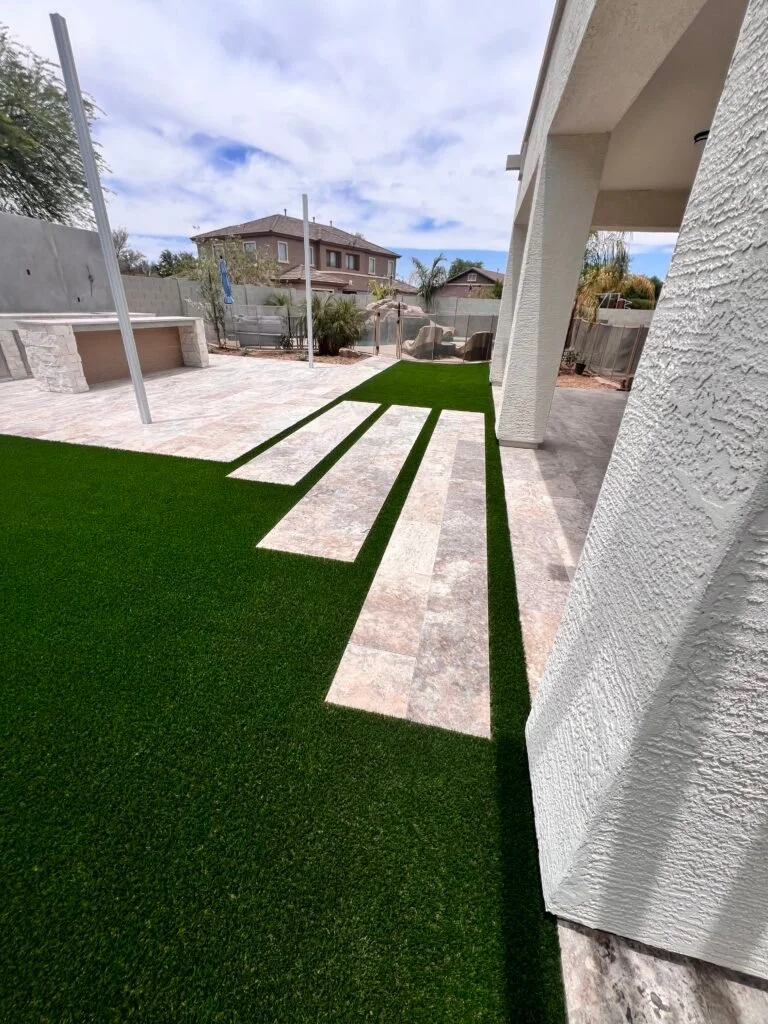
Can I get lawn stripes on a yard with pavers or stepping stones installed?
What maintenance does a striped artificial turf lawn actually require?
Serving the Phoenix Valley with Precision Turf Installs
InfinityTurf Landscaping LLC installs striped artificial turf throughout the greater Phoenix Valley metro. We're licensed in AZ and carry a 4.9-star rating across 27 Google reviews.
17Communities served · tap to explore
- Chandler
- Gilbert
- Mesa
- Scottsdale
- Tempe
- Glendale
- Peoria
- Queen Creek
- Surprise
- Goodyear
- Avondale
- Maricopa
- Ahwatukee
- Buckeye
- Paradise Valley
- Cave Creek
- Fountain Hills
Get Crisp, Permanent Lawn Stripes Installed Right
Ten years of precision turf installs across the Phoenix Valley. One call gets you a free on-site quote.